







Few people in modern India have demonstrated as clearly as Sonam Wangchuk that one individual working from a remote mountain region can reshape education policy, invent climate solutions, and shift national conversations about justice and governance.
Sonam Wangchuk’s contributions to social causes span more than three decades and cross several fields simultaneously, from alternative schooling and teacher training to glacier engineering, sustainable architecture, and constitutional advocacy for the people of Ladakh. His work is not the work of a campaigner seeking headlines.
It is the work of a builder who identified real problems and built real solutions, one community at a time. This guide covers the full scope of Sonam Wangchuk’s contributions to social causes, explaining what he did, why it mattered, and how his work continues to influence thinking far beyond the Himalayas.
Who Is Sonam Wangchuk?
Sonam Wangchuk is an Indian activist, engineer, education reformer, and environmentalist born on 1 September 1966 in Uleytokpo, a remote village in the Leh district of what was then the state of Jammu and Kashmir, now the Union Territory of Ladakh. He studied mechanical engineering at the National Institute of Technology in Srinagar. He returned to Ladakh after graduation not to pursue a conventional engineering career but to address the profound failures of the education system that he had personally experienced as a child.
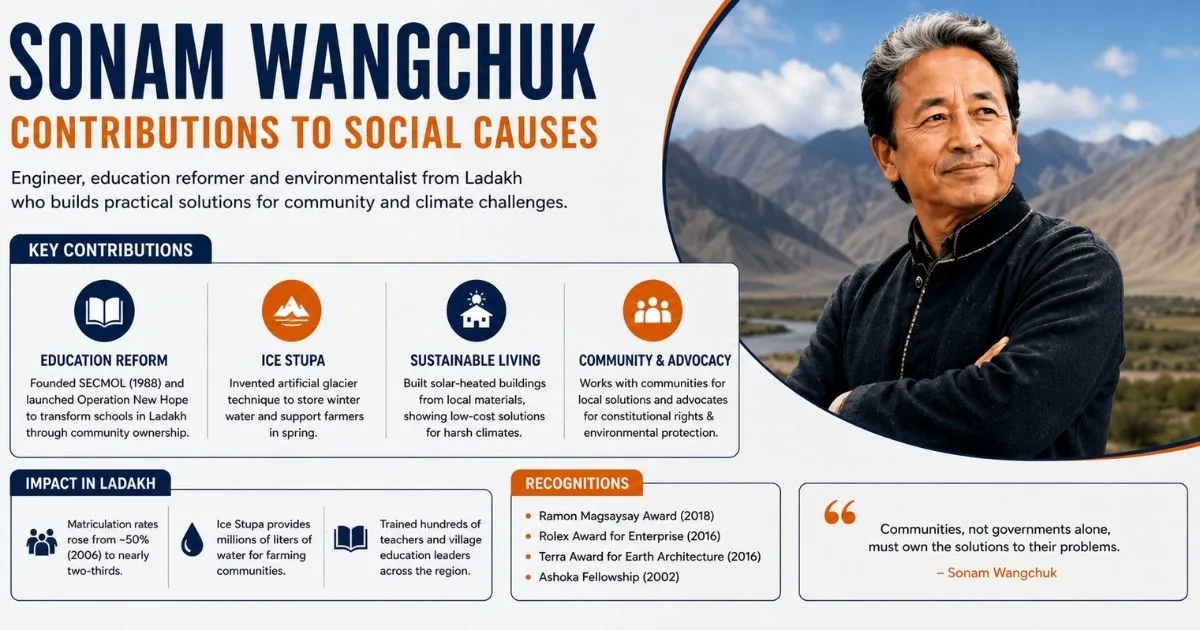
He is the founding director of the Students’ Educational and Cultural Movement of Ladakh (SECMOL), founded in 1988. He is the inventor of the Ice Stupa artificial glacier technique. He is the recipient of the Ramon Magsaysay Award, the Rolex Award for Enterprise (2016), the Terra Award for Earth Architecture (2016), and an Ashoka Fellowship (2002). His story inspired the character of Phunsukh Wangdu in the 2009 Aamir Khan film 3 Idiots, directed by Rajkumar Hirani, which brought him to the attention of hundreds of millions of people across South Asia and beyond.
Sonam Wangchuk’s contributions to social causes are grounded in a simple but radical belief: that communities, not governments alone, must own the solutions to their problems, and that education and environment are not separate concerns but two dimensions of the same challenge.
Early Life: The Education That Failed Him
To understand Sonam Wangchuk’s contributions to social causes, it is essential to begin with the failure that motivated them. He grew up in a small village with no school. His mother, Tsering Wangmo, who had never attended school herself, taught him everything in his native Ladakhi language during his earliest years. He has described her as “never schooled but highly educated,” a distinction that proved foundational to his later philosophy of education.
At the age of nine, when his father Sonam Wangyal was elected to the Jammu and Kashmir government as a minister, the family relocated to Srinagar. Wangchuk was enrolled in a school where lessons were conducted in Urdu and Kashmiri, languages he did not speak.
Teachers mistook his silence for low intelligence. He was treated poorly and recalls this period as among the darkest of his life. He eventually left and made his way alone to Delhi, where he enrolled in a Kendriya Vidyalaya school serving children from border areas. There, he encountered teachers who recognized his potential. “My teachers in Delhi made a star out of nothing,” he later recalled.
That contrast, between a system that labeled him a failure and a system that allowed him to flourish, became the lens through which Sonam Wangchuk’s contributions to social causes were later designed. He understood from personal experience what it cost a child to be failed by an irrelevant educational system, and he spent decades building alternatives.
SECMOL: The Foundation of Sonam Wangchuk’s Contributions to Social Causes
In 1988, at the age of 22 and immediately after completing his engineering degree, Sonam Wangchuk co-founded the Students’ Educational and Cultural Movement of Ladakh (SECMOL) with his brother and five peers. The founding premise was direct and urgent. At that time, approximately 95 percent of Ladakhi students were failing their state examinations. The cause was not student inability. It was a curriculum delivered in Urdu, a language foreign to most Ladakhi children, by teachers trained in methods that had no connection to the region’s culture, geography, or practical needs.
SECMOL began with a different question. Instead of asking why students were failing, it asked why the system was producing failure at that scale. That reorientation from blaming students to analyzing the system was one of the most significant intellectual contributions at the core of Sonam Wangchuk’s contributions to social causes.
SECMOL established an alternative school campus near Leh with a remarkable admission policy: the entrance criterion was failure in government exams, not academic achievement. Students who the conventional system had rejected were admitted and given a chance to learn through practical, community-relevant methods. The campus itself was built by students and teachers together, using local earth and mud materials. Solar heating systems maintained interior temperatures above +15 degrees Celsius even when outdoor temperatures dropped to -15 degrees Celsius in Ladakhi winters. The campus ran entirely on solar energy, with no fossil fuels used for cooking, heating, or lighting.
This made the SECMOL campus itself an expression of Sonam Wangchuk’s contributions to social causes: a place where education, sustainability, and community ownership were not separate goals but a single integrated vision.
Operation New Hope: Reforming the Government School System
One of the most structurally significant of Sonam Wangchuk’s contributions to social causes was Operation New Hope, launched in 1994. This was not a private school initiative. It was a systemic intervention designed to reform the government school system across Ladakh through a triangular partnership between government education departments, village communities, and civil society organizations.
The programme worked on several levels simultaneously. Village Education Committees were formed to give communities direct ownership of their local government schools. Villagers were asked to contribute financially toward teacher training, which created a personal stake in the process and transformed passive observers into active monitors of educational quality. Teachers were trained in child-friendly methods and held accountable to the communities they served rather than only to distant bureaucracies.
Crucially, Operation New Hope also addressed the curriculum itself. Working with government authorities, Wangchuk and his team introduced locally relevant textbooks, promoted the use of Ladakhi language at primary levels, and advocated for English language instruction at the primary stage, which was formally introduced in 1992 in part through these advocacy efforts. By rewriting the curriculum around Ladakhi life, geography, and culture, the programme made schooling relevant for the first time to an entire generation of children.
The measurable results of this dimension of Sonam Wangchuk’s contributions to social causes are significant. Matriculation rates in Ladakhi government schools rose from approximately 50 percent in 2006 to nearly two thirds of students in the years that followed. The Ashoka Foundation, which awarded Wangchuk a fellowship in 2002, documented that the reform effort trained hundreds of teachers and village education leaders across the region.
The Ice Stupa: Climate Innovation as a Social Cause
The most internationally recognized of Sonam Wangchuk’s contributions to social causes is the Ice Stupa, an artificial glacier technique he developed to address the water crisis facing Ladakhi farming communities.
The problem was specific and devastating. Glaciers in the Ladakh region have been melting at accelerating rates due to climate change. But the timing of that meltwater was itself part of the crisis. Glacial water is most abundant in the summer months when the melt is at its peak. Farmers, however, need water most urgently in spring, when crops are being planted and glacial melt has not yet begun. The gap between when water was available and when it was needed was leaving farms dry and communities food-insecure at the most critical moment of the agricultural calendar.
Wangchuk’s solution was inspired by an older Ladakhi tradition of making small ice patches. He designed a system to pipe stream water uphill during winter months, when the water was flowing but less needed. At the exit point, the water freezes and accumulates into a tall conical ice structure, shaped deliberately like the Buddhist stupas that are a central feature of Ladakhi cultural and religious life. The cone shape maximizes the ratio of volume to surface area exposed to sunlight, which causes the structure to melt more slowly than a flat ice field, extending the water supply further into the spring planting season.
A prototype tested in 2014 lasted until early July and released approximately 1.5 million liters of meltwater, supporting 5,000 saplings planted by local communities. The technique has since been replicated in other cold desert regions around the world including Switzerland and Kyrgyzstan, where similar high-altitude farming communities face comparable water timing challenges.
Sonam Wangchuk’s contributions to social causes through the Ice Stupa demonstrate something important: the most effective environmental innovations are also social innovations. The Ice Stupa is not simply a scientific curiosity. It is a community water system that protects farming livelihoods, food security, and the cultural continuity of mountain communities facing climate disruption.
HIAL: Higher Education With a Social Mission
Building on the philosophy developed through SECMOL and the practical experience of the Ice Stupa project, Sonam Wangchuk played a central role in establishing the Himalayan Institute of Alternatives Ladakh (HIAL), a higher education institution designed to serve the specific developmental needs of mountain regions.
HIAL operates on an educational philosophy summarized as “Bright Head, Kind Heart, and Skilled Hands”, a deliberate departure from conventional academic emphasis on knowledge retention alone. The institute provides education and training in areas directly relevant to Ladakh’s development needs, including sustainable livelihoods, water conservation, energy-efficient housing, eco-tourism, and agricultural innovation.
Sonam Wangchuk’s contributions to social causes through HIAL extend the logic of SECMOL into higher education. Just as SECMOL challenged the assumption that primary and secondary education should be delivered through a one-size-fits-all national model, HIAL challenges the assumption that higher education should funnel young people from remote mountain regions into urban professional careers disconnected from their home communities.
Sustainable Architecture: Buildings as a Social Statement
One of the less widely discussed but genuinely significant of Sonam Wangchuk’s contributions to social causes is his work in sustainable building design in Ladakh’s extreme mountain climate.
At the SECMOL campus, Wangchuk led the design and construction of solar-heated buildings made from locally available earth and mud. These structures maintain interior temperatures above +15 degrees Celsius during Ladakhi winters when outside temperatures drop to -15 degrees Celsius, without using any fossil fuels for heating. The buildings use passive solar design principles adapted to the specific orientation, elevation, and climate of the Leh Valley.
This work earned him the UNESCO Chair for Earth Architecture in India in 2014 and the Terra Award for the World’s Best Earth Buildings in Lyon, France, in 2016. These recognitions confirm that Wangchuk’s building designs are not local curiosities but internationally recognized contributions to sustainable architecture.
The social dimension of this work is direct. In a region where winters are severe, heating fuel is expensive and difficult to obtain, and climate-resilient infrastructure is urgently needed, low-cost solar buildings represent a practical and replicable solution to community welfare challenges.
Awards and Recognition: A Summary
| Award | Year | Awarding Body |
| Ramon Magsaysay Award | 2018 | Ramon Magsaysay Award Foundation |
| Rolex Award for Enterprise | 2016 | Rolex SA |
| Terra Award (World’s Best Earth Buildings) | 2016 | CRATerre, Lyon, France |
| UNESCO Chair for Earth Architecture, India | 2014 | UNESCO |
| Ashoka Fellowship | 2002 | Ashoka: Innovators for the Public |
| Real Heroes Award | 2008 | CNN IBN Channel |
| Green Teacher Award | 2005 | Sanctuary Asia Magazine |
These awards collectively reflect the breadth of Sonam Wangchuk’s contributions to social causes. They span education, environmental innovation, architectural sustainability, and social entrepreneurship, confirming that his work crosses disciplinary boundaries in ways that few individuals manage to sustain across decades.
Political Advocacy: The Constitutional Demand for Ladakh
Sonam Wangchuk’s contributions to social causes have extended increasingly into political advocacy in recent years, particularly around the constitutional status of Ladakh. When the Indian government reorganized Jammu and Kashmir in August 2019, Ladakh was made a separate Union Territory but, unlike Jammu and Kashmir, was not granted its own elected legislature.
Wangchuk argued publicly that this arrangement left Ladakh’s communities without adequate political representation or constitutional protections for their land, culture, and environment. He called for Ladakh’s inclusion under the Sixth Schedule of the Indian Constitution, which provides special protections for tribal communities in northeastern India and has historically been applied to protect indigenous land rights and cultural autonomy.
In January 2023, he began a climate fast at Khardung La, one of the highest motorable mountain passes in the world, to highlight the effects of climate change on Ladakh’s fragile ecosystem and to demand constitutional protections. He was placed under house detention. In September 2025, he was arrested and held under the National Security Act for 170 days in connection with his activism. On 14 March 2026, the Ministry of Home Affairs revoked his detention and he was released from Jodhpur Central Jail.
His detention drew international concern from environmentalists, civil society organizations, and human rights advocates. The arrest highlighted the tension between his role as an innovation-focused social reformer and his increasingly direct challenges to Indian government policy in Ladakh.
Read also: Braves Marcell Ozuna Waiver Candidate: The Complete Story Behind the 2025 Rumors and 2026 Outcome
The “3 Idiots” Effect: Global Attention on a Local Mission
In 2009, the Bollywood film 3 Idiots was released, directed by Rajkumar Hirani and starring Aamir Khan. The character of Phunsukh Wangdu, an unconventional thinker who invents practical solutions and challenges the failures of the conventional education system, was inspired in part by Sonam Wangchuk’s life and work.
The film became one of the highest-grossing Bollywood productions in history, introducing hundreds of millions of viewers across India and globally to the broad outlines of a story that paralleled Wangchuk’s actual contributions. His name entered mainstream awareness at a scale that no individual education reform project could achieve on its own.
Wangchuk has been careful to note that the film was inspired by his life, not directly based on it, and that the fictional portrayal simplified and dramatized elements that were in reality the product of years of patient, unglamorous community work. Nevertheless, the attention the film brought enabled him to reach broader audiences with messages about education reform and environmental sustainability.
The Boycott China Campaign: Wallet Power as Social Advocacy
In June 2020, following the clash between Indian and Chinese soldiers in the Galwan Valley in Ladakh, Sonam Wangchuk made a direct and widely shared video appeal calling on Indian citizens to use their “wallet power” to boycott Chinese products. He argued that economic choices by individual consumers could send a meaningful signal about support for the soldiers defending India’s borders.
The appeal received national and international media coverage and was shared by several prominent Indian celebrities. It represented Sonam Wangchuk’s contributions to social causes extending into the domain of economic and geopolitical advocacy, using social media not merely for awareness but for a specific behavioral call to action directed at hundreds of millions of consumers.
Comparison: Sonam Wangchuk’s Key Social Initiatives
| Initiative | Year | Social Impact |
| SECMOL | 1988 | Alternative schooling for exam-failed students in Ladakh |
| Operation New Hope | 1994 | Government school reform across Ladakh through community ownership |
| Ladags Melong Magazine | 1993 to 2005 | Ladakh’s only print magazine, local language media |
| Ice Stupa | 2014 | Artificial glacier providing spring irrigation water to farmers |
| HIAL | 2016 onwards | Higher education focused on mountain development needs |
| Climate Fast, Khardung La | 2023 | Protest demanding constitutional protection for Ladakh’s ecology |
| Sixth Schedule Campaign | 2023 to 2026 | Constitutional advocacy for Ladakh’s tribal land and governance rights |
Why Sonam Wangchuk’s Contributions to Social Causes Remain Relevant
Sonam Wangchuk’s contributions to social causes are relevant beyond Ladakh because the problems he addressed are universal, even if the geography is specific. The failure of standardized education systems to serve linguistically and culturally diverse populations is a global challenge.
The gap between available water and agricultural need is expanding across many mountain and semi-arid regions worldwide as glaciers recede. The tension between central government authority and the constitutional rights of indigenous and minority communities is a recurring conflict in democracies on every continent.
What makes Sonam Wangchuk’s contributions to social causes instructive is the method as much as the content. He built from the community upward rather than from policy downward. He identified problems through personal experience rather than external research. He created solutions that the communities themselves could own, maintain, and replicate. And he connected education, environment, and governance as three dimensions of a single social challenge rather than treating them as separate policy domains.
That integrative approach, grounded in lived experience and built through patient community collaboration, is the most enduring element of his work. It explains why his projects continue to function decades after their inception and why the ideas behind them have spread well beyond the Himalayan region where they were first developed.
Conclusion
Sonam Wangchuk’s contributions to social causes represent one of the most coherent and sustained bodies of community-centered social innovation produced in India in the past four decades. From the founding of SECMOL in 1988 to the climate fast of 2023 and the detention that followed in 2025, his trajectory is that of a person who identified real problems and built real solutions without waiting for institutional permission or external funding to validate the effort.
His work demonstrates that education reform and environmental innovation are not competing priorities. In Ladakh, they are the same priority approached from different angles. Water access determines food security. Food security determines community stability.
Community stability determines whether children can attend school and whether young people have futures in their home regions. Sonam Wangchuk’s contributions to social causes connect all of these dimensions into a single, coherent response to the challenges facing one of the world’s most remarkable and fragile mountain landscapes.
The awards, the global attention, and the political controversies of recent years have not changed the fundamental character of the work. It remains what it has always been: practical, community-owned, and built to last.
Frequently Asked Questions
What are Sonam Wangchuk’s main contributions to social causes?
His primary contributions include founding SECMOL in 1988 to reform education in Ladakh, leading Operation New Hope to improve government schools through community ownership, inventing the Ice Stupa artificial glacier to address water scarcity for farmers, and establishing HIAL as a higher education institution for mountain communities.
What is the Ice Stupa and why does it matter socially?
The Ice Stupa is an artificial glacier that stores winter stream water in cone-shaped ice structures that melt slowly through spring, providing irrigation water to Ladakhi farmers when glacial melt has not yet begun. Its social significance is that it protects farming livelihoods and food security in communities facing climate-driven water shortages.
What awards has Sonam Wangchuk received?
He has received the Ramon Magsaysay Award (2018), the Rolex Award for Enterprise (2016), the Terra Award for Earth Architecture (2016), the UNESCO Chair for Earth Architecture in India (2014), the Ashoka Fellowship (2002), and several Indian national media awards including the CNN IBN Real Heroes Award (2008).
Why was Sonam Wangchuk arrested in 2025?
He was arrested in September 2025 and held under the National Security Act for 170 days in connection with his activism demanding constitutional protections for Ladakh, including inclusion under the Sixth Schedule of the Indian Constitution. He was released on 14 March 2026 after the Ministry of Home Affairs revoked his detention.
How did the film 3 Idiots relate to Sonam Wangchuk?
The 2009 Bollywood film 3 Idiots, starring Aamir Khan, featured a character named Phunsukh Wangdu who was inspired in part by Wangchuk’s life. The film brought global attention to ideas about alternative education that aligned with his work in Ladakh, though Wangchuk has noted the character was inspired by, not directly based on, his actual biography.
Read also: Serlig Explained: What It Means, Where It Came From, and Why It Matters Today