








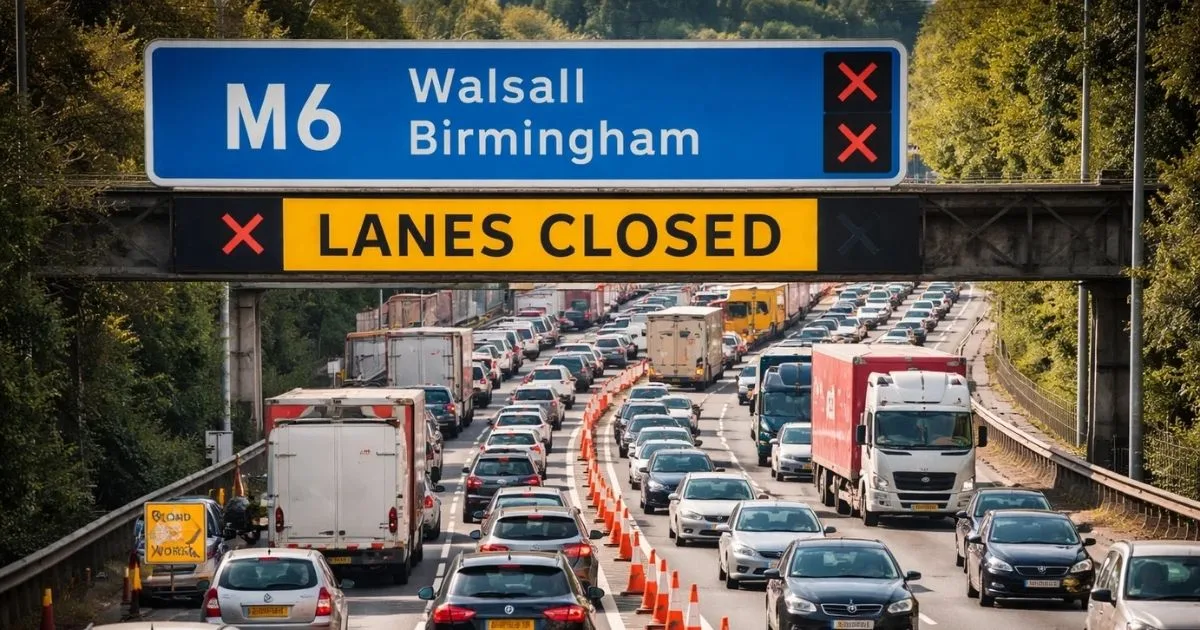
Thousands of drivers across the West Midlands face disruption every week on one of England’s busiest motorway corridors. The M6 Walsall Birmingham lanes closure has become a recurring challenge for commuters, freight operators, and local businesses alike.
Whether the cause is a road traffic accident, a broken-down vehicle, or planned maintenance by National Highways, the impact spreads quickly across the wider road network. This guide explains everything drivers need to know, including the key junctions affected, the main causes of closures, diversion options, and how to stay informed during ongoing works in 2025 and 2026.
What Is the M6 Walsall Birmingham Lanes Closure?
The M6 Walsall Birmingham lanes closure refers to any full or partial lane restriction on the M6 motorway between the Walsall and Birmingham sections of the West Midlands. This stretch is one of the most heavily trafficked sections of the entire M6 motorway, handling a large volume of daily commuters, heavy goods vehicles, and long-distance traffic.
The affected area primarily covers the section between Junction 7 (Great Barr) and Junction 10 (Walsall/Wolverhampton), with frequent disruption also reported around Junction 6 (Spaghetti Junction) and Junction 10A (M54 link). Lane closures on this corridor, whether planned or unplanned, consistently trigger delays that ripple outward across connecting roads and motorways.
National Highways, the government-owned company responsible for England’s strategic road network, manages this section. Closures are typically announced through Traffic England and official signage on approach roads.
Key Junctions Affected Between Walsall and Birmingham
Understanding the junction layout helps drivers choose the most effective alternative routes when disruption occurs.
Junction 6 is known nationally as Spaghetti Junction and connects the M6 with the A38(M) Aston Expressway. It is one of the most complex interchanges in the UK and a critical pressure point when lane closures occur nearby. Even minor incidents at or near Junction 6 can cause delays extending several miles in both directions.
Junction 7 serves Great Barr and provides access to Walsall via the A34. This junction sees heavy commuter use and is a primary exit point for traffic heading into Walsall from the south. Closures here directly affect journeys between Birmingham city centre and Walsall town centre.
Junction 8 links the M6 with the M5 motorway, making it a critical interchange for regional and national traffic. Problems at Junction 8 affect not just local commuters but also long-distance freight moving between the Midlands and the South West.
Junction 10 serves Walsall and Wolverhampton and has been a focal point for ongoing infrastructure improvement works. This junction has undergone significant upgrade works in recent years, with new bridge structures and wider approach roads completed as part of a broader improvement scheme.
Junction 10A connects the M6 to the M54, which leads toward Telford and Shropshire. When closures occur between Junction 10 and 10A, traffic heading northwest faces particularly severe delays.
Main Causes of Lane Closures on This Section
Several distinct factors trigger lane closures on the M6 between Walsall and Birmingham. Each carries different implications for duration, severity, and advance warning.
Road traffic accidents are the most frequent unplanned cause. Collisions on this stretch range from minor rear-end incidents to serious multi-vehicle crashes involving heavy goods vehicles. A significant collision in November 2025 closed three northbound lanes near Junction 10 and caused delays exceeding 90 minutes. Fatal accidents, when they occur, require the carriageway to remain closed for several hours to allow police investigation and vehicle recovery.
Vehicle breakdowns are a daily occurrence on this busy section. A single stranded lorry blocking a live lane can reduce capacity significantly, creating queues that build rapidly during morning and evening peak periods. The hard shoulder on the northbound carriageway between Junctions 6 and 7 has seen repeated closures due to breakdown incidents.
Planned maintenance works by National Highways generate predictable closures that are typically announced several days in advance. These works usually take place overnight, between 8pm and 6am on weekdays, to reduce the impact on daytime traffic. Resurfacing, barrier repairs, drainage works, and structural inspections all require lane restrictions for worker safety.
Bridge and infrastructure works have been particularly significant on this corridor. The Bescot Viaduct near Walsall has required periodic maintenance, and bridge repair works near Junctions 5 and 6 were active in early 2026. These structural works sometimes require overnight full carriageway closures with signed diversions in place.
Timeline of Recent Closures and Works
The M6 Walsall Birmingham section has experienced a consistent schedule of both planned and unplanned disruption throughout 2025 and into 2026.
Between October and November 2025, overnight southbound closures operated between Junction 12 and Junction 10, covering sections relevant to both Walsall and Birmingham-bound traffic. These works focused on safety upgrades and resurfacing.
In November 2025, a serious accident on the northbound carriageway near Junction 10 closed three lanes and caused delays of more than 90 minutes during peak evening hours. A separate two-lane closure near Walsall following a collision in early November caused significant backlog before normal conditions returned.
From July 2025 to April 2026, National Highways conducted extensive overnight works on the northbound and southbound carriageways between Junctions 6 and 7. These works used a combination of lane restrictions and full closures, with signed diversions activated for full carriageway closures.
From March to April 2026, full carriageway closures between Junctions 6 and 4 operated on weeknights between 9pm and 6am. Diversion routes were put in place to guide southbound traffic away from the affected section.
Spring 2026 brought further resurfacing and upgrade works across multiple sections between Walsall and Birmingham, with disruption expected to continue in phases as the programme progresses.
How Lane Closures Affect Traffic Across the Region
When lanes close on the M6 between Walsall and Birmingham, the effects extend well beyond the motorway itself. Traffic that would normally pass through quickly instead backs up over several miles, increasing journey times for everyone on the network.
During peak hours, delays on this section have regularly reached 30 to 60 minutes. Serious incidents have pushed waiting times beyond 90 minutes. Traffic officers and National Highways both advise drivers to allow significant additional time whenever lane restrictions are in operation.
The congestion spreads outward in predictable ways. The M5 southbound and M42 both see increased volumes as drivers seek alternatives. Local Birmingham roads including the A34, A38, and A41 experience heavier traffic than usual, which in turn creates delays in residential and commercial areas adjacent to the motorway network.
Heavy goods vehicle diversions compound the problem further. When lorries are redirected onto local roads, those routes face additional stress from vehicles they were not designed to accommodate regularly.
Alternative Routes When the M6 Is Closed
Drivers who know the alternative options in advance can avoid the worst of the delays when closures occur between Walsall and Birmingham.
| Route | Direction Served | Notes |
| M6 Toll | Northbound bypass | Avoids J7 to J11A entirely. Toll charges apply. |
| A34 Birmingham Road | Walsall to Birmingham | Viable but congests quickly during incidents |
| A38 (A38(M) Aston Expressway) | Birmingham city centre access | Use when J6 area is affected |
| M5 then M6 | Southwest bypass | Adds distance but bypasses the core affected section |
| M42 then A38 | Southeast approach | Useful for traffic from the south and east |
| A41 Wolverhampton Road | Walsall to Birmingham | Local alternative through West Bromwich |
The M6 Toll remains the most effective high-capacity alternative for northbound and southbound traffic bypassing the Walsall to Birmingham section. It avoids the busiest junctions entirely. However, it carries a toll charge and is not free for heavy goods vehicles on standard routes.
Navigation apps including Google Maps, Waze, and Apple Maps update in real time during incidents and can suggest the most current alternative routes based on live traffic data.
Overnight Closure Schedules and What to Expect
National Highways typically operates planned works under overnight closure schedules to minimise disruption to daytime commuters. On the M6 Walsall Birmingham section, overnight closures generally follow these patterns.
Weeknight closures usually begin between 8pm and 10pm and lift before 6am the following morning. Full carriageway closures, where both lanes are shut, are less common but used when the scale of work requires complete access to the road surface.
During full closures, signed diversion routes are activated in advance of the closure point. These diversions guide drivers off the motorway at a preceding junction and back on at the junction beyond the works. Drivers should follow the yellow diversion signs rather than relying solely on navigation apps during active full closures, as some apps may attempt to route through roads that are not suitable for all vehicle types.
Emergency vehicles retain access throughout all planned closures. National Highways publishes detailed closure information on its daily closures page, and Traffic England provides live information on network conditions.
Impact on Freight and Logistics
The M6 Walsall Birmingham corridor is a primary route for freight movement across the Midlands. Heavy goods vehicles use this section to move goods between manufacturing sites, distribution centres, and the national motorway network. Lane closures directly increase delivery times and fuel costs for logistics operators.
When the M6 is restricted, lorries are often diverted to the M6 Toll or local A roads. Both options add time and distance to journeys. For time-sensitive deliveries, this creates measurable operational cost increases. Logistics firms operating regularly in the West Midlands generally monitor National Highways announcements and plan route changes before major closures begin.
Environmental Impact of Traffic Congestion
Extended congestion caused by lane closures carries environmental consequences that go beyond driver inconvenience. Vehicles idling or moving slowly in heavy traffic consume significantly more fuel than vehicles travelling at motorway speed. This increases carbon dioxide emissions across the affected network.
In urban areas like Birmingham, where air quality is already a monitored public health concern, extended traffic jams worsen local pollution levels. The area around the M6 in Birmingham and Walsall falls within zones where air quality improvements are a stated local authority priority.
Encouraging the use of alternative transport during closure periods, including rail services between Walsall and Birmingham, helps reduce the total number of vehicles on diverted routes. Walsall station and Birmingham New Street both provide frequent direct connections, making rail a practical option for non-freight journeys.
Read also: Authorised Medical Attendant Explained: Role, Duties, and Importance in Healthcare
How to Stay Informed About M6 Closures
Several reliable sources provide accurate and timely information about lane closures on the M6 between Walsall and Birmingham.
National Highways publishes planned closure information on its website at nationalhighways.co.uk, including specific dates, times, and affected junctions. Its daily closures page is updated regularly and is the most authoritative source for planned works.
Traffic England provides live network information including real-time incidents, congestion levels, and active closures. This is the best source for checking conditions immediately before or during a journey.
Walsall Council and Birmingham City Council both maintain roadworks information pages showing closures affecting their road networks, including motorway sections managed by National Highways.
Navigation apps including Google Maps, Waze, and Apple Maps integrate live traffic data and reroute dynamically during incidents. These are most useful for real-time journey planning rather than checking future scheduled works.
Traffic alert services from National Highways allow drivers to sign up for email or text notifications about planned works on specific routes, providing advance notice before closures begin.
Tips for Drivers Affected by M6 Closures
Simple steps taken before and during a journey can significantly reduce the impact of lane closures on this section of the M6.
Check National Highways and Traffic England before departing, particularly for evening journeys when overnight works are most likely to be in force. Allow at least 30 additional minutes during periods when lane restrictions are confirmed. Consider travelling before 7am or after 8pm on weekdays to avoid peak congestion windows around active works.
If using the M6 Toll as an alternative, prepare payment in advance to avoid delays at the toll plaza. When diversion signs are active, follow them rather than making independent routing decisions based on navigation apps alone.
For regular commuters, carpooling with colleagues reduces the total number of vehicles on diversion routes during closure periods, which benefits all road users in the area.
Future Improvements Planned for This Section
The closures on the M6 Walsall Birmingham section are not only disruptive in the short term. They are also part of a longer-term programme of improvements designed to make the corridor safer and more efficient.
Junction 10 at Walsall has already received significant investment, with new bridge structures and wider approach roads completed as part of an improvement scheme. These changes aim to reduce future congestion at one of the network’s most consistently busy interchange points.
Future plans for this section of the M6 include integration of variable speed limit technology, which uses overhead gantry signs to manage traffic flow in real time and reduce the stop-start congestion that builds around incidents. Drainage improvements and regular resurfacing programmes aim to reduce unplanned emergency closures caused by road surface deterioration.
Transport for West Midlands is also developing a dedicated bus priority corridor linking Walsall with Birmingham city centre, Solihull, and Birmingham Airport. This project, running along the A34, is designed to provide a reliable high-frequency public transport alternative to the congested M6 corridor.
Conclusion
The M6 Walsall Birmingham lanes closure is a persistent challenge for one of the UK’s most critical transport corridors. Accidents, vehicle breakdowns, and an active schedule of maintenance and improvement works all contribute to frequent disruption on a stretch of motorway that carries enormous volumes of daily traffic.
Understanding the key junctions, the main causes of closures, and the best alternative routes puts drivers in a much stronger position to manage their journeys effectively. Checking reliable sources before travelling, allowing extra time during known closure periods, and using the M6 Toll or A-road alternatives when appropriate can reduce the impact significantly.
The long-term improvements being carried out on this section will eventually deliver a safer and better-performing motorway. In the meantime, staying informed remains the most effective tool available to anyone travelling between Walsall and Birmingham on the M6.
Frequently Asked Questions
What is the M6 Walsall Birmingham lanes closure?
It refers to lane or carriageway restrictions on the M6 motorway between Walsall (Junction 10) and Birmingham (Junction 6 or 7), caused by accidents, maintenance works, or infrastructure upgrades.
How long do M6 lane closures typically last between Walsall and Birmingham?
Planned overnight closures usually operate between 8pm and 6am. Accident-related closures vary from 30 minutes to several hours depending on severity.
Which alternative routes should drivers use during M6 closures near Walsall?
The M6 Toll is the most effective bypass. The A34, A41, M5, and M42 are also used depending on the direction of travel and the specific junction affected.
Who manages the M6 motorway between Walsall and Birmingham?
National Highways manages the M6 on this section. Walsall Council and Birmingham City Council manage connecting local roads.
Where can drivers find live M6 traffic updates for the Walsall and Birmingham area?
Traffic England at trafficengland.com and the National Highways website provide the most accurate live and planned closure information for this section of the M6.
Read also: Abradore Explained: The Complete Guide to This Intelligent Hybrid Dog