








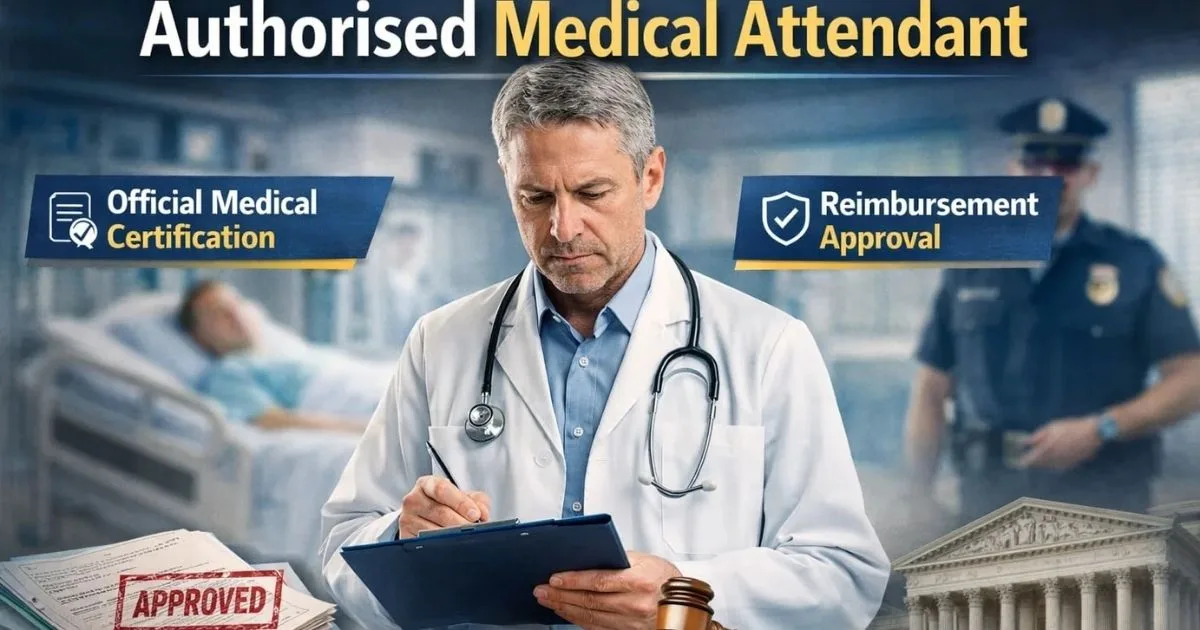
Healthcare systems are built on layers of professional oversight that most people never see. One of the most important yet least understood roles within this structure is the authorised medical attendant. Whether you work for a government department, a large corporation, or a regulated industry such as aviation or mining, the authorised medical attendant is likely the professional who approves your medical certificates, validates your treatment, and determines your eligibility for medical reimbursement.
This guide explains everything clearly, from what an authorised medical attendant is and how the role developed to the specific duties involved, the qualifications required, and why this professional is so essential to organised healthcare delivery worldwide.
What Is an Authorised Medical Attendant?
An authorised medical attendant, commonly abbreviated as AMA, is a licensed medical practitioner who has been formally approved by a government body, employer, or regulatory organisation to provide medical treatment, issue health certifications, and validate medical claims for a specific group of beneficiaries.
This group typically includes employees of the approving organisation and, in many cases, their immediate family members. The authorised medical attendant is not simply a treating physician. The role carries a specific administrative and regulatory authority that distinguishes it from general private practice.
An authorised medical attendant must balance two distinct responsibilities simultaneously: delivering genuine clinical care to patients and upholding the administrative standards and financial controls of the organisation that has authorised them. This dual function makes the authorised medical attendant a uniquely important figure within any structured occupational health system.
History and Background of the Authorised Medical Attendant Role
The concept of the authorised medical attendant has its roots in the industrial expansion of the nineteenth and early twentieth centuries. As factories, railways, mining operations, and government departments grew in scale, the need for structured medical oversight became impossible to ignore.
Workers were experiencing injuries and occupational diseases that required organised treatment and compensation frameworks. Governments and large employers began designating specific doctors to provide treatment, certify illness, and approve compensation claims within defined frameworks. Over time, these arrangements became formalised through labour laws, occupational health regulations, and industry-specific medical standards.
Today, the authorised medical attendant system operates across dozens of countries and industries, each with its own regulatory framework but sharing a common underlying purpose: ensuring that employees receive reliable medical care while protecting organisations from unverified or fraudulent claims.
How the Authorised Medical Attendant System Works
The authorised medical attendant system operates through a straightforward but carefully structured process.
When an employee requires medical attention, they consult the designated authorised medical attendant rather than seeking treatment independently. The authorised medical attendant assesses the condition, provides or recommends appropriate treatment, and issues the necessary documentation.
If the condition requires specialist care, the authorised medical attendant provides a formal referral. Without this referral, many organisations will not approve reimbursement for specialist treatment costs. When the employee has completed treatment, the authorised medical attendant certifies the medical expenses, confirms that the treatment was appropriate and necessary, and submits or approves the claim for reimbursement.
This process ensures that every step of the medical journey is documented, verified, and aligned with the organisation’s approved healthcare framework.
Key Duties of an Authorised Medical Attendant
The authorised medical attendant performs a wide range of clinical and administrative responsibilities. Understanding these duties clearly is important for both employees navigating the system and organisations managing their healthcare obligations.
Medical consultation and treatment is the foundation of the role. The authorised medical attendant provides direct clinical care for common conditions, workplace injuries, and occupational health concerns. Fitness certification is another core function.
The authorised medical attendant issues fitness-for-duty certificates that confirm whether an employee is medically capable of performing their work safely. Sick leave approval falls within the authorised medical attendant’s remit. In most structured systems, sick leave beyond a defined period must be certified by the authorised medical attendant before it is formally approved.
Referral management ensures that patients requiring specialist input are directed to appropriate providers through a verified pathway. Medical reimbursement validation is one of the most significant administrative responsibilities. The authorised medical attendant certifies that treatment expenses are genuine, appropriate, and eligible for reimbursement under the applicable rules.
Preventive health screening is increasingly part of the role, with many organisations requiring the authorised medical attendant to conduct periodic health checks across the workforce.
Qualifications Required to Become an Authorised Medical Attendant
Becoming an authorised medical attendant requires meeting specific professional and regulatory criteria that vary by industry and jurisdiction. In most systems, the following qualifications and conditions apply.
A full medical degree, typically an MBBS or equivalent, is the minimum academic requirement. Registration with the relevant national or state medical council confirms that the practitioner is legally qualified to practise medicine.
Beyond this foundation, many industries require additional training. In aviation, the authorised medical attendant must complete training in aerospace medicine and the physiological effects of altitude on the human body. In mining, the role typically requires expertise in respiratory medicine, dust-related disease, and occupational toxicology.
Many public sector systems additionally require that the practitioner hold a specific designation issued by the employing government department before they may act as an authorised medical attendant for its employees. Ongoing continuing professional development is expected across all industries to ensure that the authorised medical attendant remains current with regulatory changes and clinical best practices.
Authorised Medical Attendant Across Different Industries
The authorised medical attendant role takes on different characteristics depending on the industry in which it operates. Understanding these variations helps clarify why the role is described differently in different professional contexts.
| Industry | Primary Focus | Key Responsibilities |
| Government / Public Sector | Employee health and reimbursement | Treatment, sick leave certification, claims approval |
| Aviation | Pilot and crew fitness | Medical certificates Class 1 to Class 3, psychological assessment |
| Mining | Occupational disease prevention | Lung function testing, dust exposure monitoring, radiographic screening |
| Railways | Employee fitness for safety-critical roles | Fitness certification, injury management, periodic screening |
| Corporate / Private Sector | Workforce health management | Occupational screening, rehabilitation oversight, claims validation |
| Aviation Passenger Care | In-flight medical support | Medical attendance for passengers requiring care during flight |
In aviation specifically, the authorised medical attendant plays a distinct role in two separate contexts. The first is as an aviation medical examiner responsible for issuing pilot medical certificates.
The second is as a professional designated to accompany a passenger who requires medical supervision during a flight. Both contexts carry the same foundational requirement: formal authorisation from a recognised regulatory body.
The Authorised Medical Attendant and Medical Reimbursement
One of the most practically important functions of the authorised medical attendant is the verification of medical reimbursement claims. In government and large corporate healthcare systems, employees are entitled to have medical expenses reimbursed, but only when those expenses have been certified by the authorised medical attendant as necessary, appropriate, and consistent with approved treatment guidelines.
This function prevents both deliberate fraud and unintentional overclaiming. The authorised medical attendant reviews prescriptions, treatment plans, hospital admission records, and diagnostic test results to confirm that each item is clinically justified. Claims that do not meet the required standards are returned for clarification or rejected.
Employees who seek treatment from providers not recognised by the system, or who fail to obtain a referral before accessing specialist care, may find their reimbursement claims denied even if the treatment itself was clinically appropriate. This makes the authorised medical attendant a critical gatekeeper whose approval is essential to accessing financial benefits within the system.
Challenges Faced by the Authorised Medical Attendant
The authorised medical attendant role is demanding in ways that purely clinical roles are not. Several consistent challenges define the professional experience of practitioners working in this capacity.
Conflict of interest management is one of the most significant. The authorised medical attendant is employed or authorised by the same organisation whose employees they treat. This creates a structural tension between acting in the patient’s clinical interest and serving the administrative requirements of the employer.
Transparent communication, clear institutional policies, and strong professional ethics are all essential to navigating this tension effectively. Administrative burden is another challenge. The volume of documentation, certification, and claims processing that falls to the authorised medical attendant can be considerable, particularly in large organisations with high employee numbers. Keeping current with regulations is an ongoing requirement.
The rules governing authorised medical attendant practice change with labour laws, healthcare policies, and industry-specific regulations. Practitioners who do not maintain current knowledge risk making decisions that are administratively invalid even when clinically sound.
Read also: Vitilinox Revealed: What It Is, How It Works, and What You Should Know Before Trying It
Technology and the Future of the Authorised Medical Attendant
Digital transformation is reshaping how the authorised medical attendant operates in every industry. Electronic health records have replaced paper-based systems in most developed healthcare environments, allowing the authorised medical attendant to access complete patient histories, track treatment outcomes, and process reimbursement claims more efficiently than was previously possible.
Automated alert systems within electronic health platforms can flag anomalies in treatment patterns, potential duplicate claims, or cases requiring clinical review, helping the authorised medical attendant manage large caseloads without compromising quality. Telemedicine has extended the reach of the authorised medical attendant in remote or distributed work environments, allowing consultations, certifications, and referrals to be conducted without physical attendance at a clinic.
As artificial intelligence tools mature within clinical settings, the authorised medical attendant will increasingly work alongside algorithmic decision-support systems that enhance diagnostic accuracy and administrative efficiency.
Tips for Employees Working With an Authorised Medical Attendant
Employees who understand how the authorised medical attendant system works are better positioned to access its benefits effectively.
Always consult the authorised medical attendant before seeking specialist treatment, as referrals are typically required for reimbursement eligibility. Keep all receipts, prescription records, and treatment documentation, as these are essential for claims processing. If admitted to hospital, notify the authorised medical attendant promptly, as prior or timely approval is often required.
Attend all scheduled health screenings arranged through the authorised medical attendant system, as non-attendance can affect access to benefits in some frameworks. If a claim is rejected, request a written explanation and review it carefully before resubmitting with additional documentation. Understanding the system’s requirements thoroughly is the most effective way to ensure that the authorised medical attendant’s role works in your favour.
Conclusion
The authorised medical attendant is one of the most structurally important professionals in any organised healthcare system. The authorised medical attendant serves as the essential connection between individual patient care and the administrative frameworks that make employer-funded and government-funded healthcare financially sustainable.
From issuing medical certificates and approving sick leave to validating reimbursement claims and managing specialist referrals, the authorised medical attendant touches every stage of the healthcare journey for the populations they serve.
As healthcare systems continue to evolve through digital innovation, regulatory reform, and changing workforce demands, the authorised medical attendant will remain a central and indispensable figure ensuring that medical care is delivered with both clinical integrity and administrative accountability.
Frequently Asked Questions
What is an authorised medical attendant?
An authorised medical attendant is a licensed medical practitioner formally approved by a government body or employer to provide treatment, issue health certifications, and validate medical reimbursement claims for a designated group of employees or beneficiaries.
How does an authorised medical attendant differ from a regular doctor?
A regular doctor provides independent clinical care, while an authorised medical attendant operates within a specific institutional framework that grants them authority to certify medical claims, approve sick leave, and issue fitness-for-duty documentation on behalf of an organisation.
Is seeing an authorised medical attendant mandatory?
In most structured government and corporate healthcare systems, consulting the authorised medical attendant is required for sick leave approval, specialist referrals, and medical reimbursement eligibility, making it effectively mandatory for accessing benefits.
What qualifications does an authorised medical attendant need?
The minimum requirement is a recognised medical degree and registration with the relevant medical council, with additional industry-specific training required in sectors such as aviation, mining, and railways.
Read also: Inflatom Explained: The Complete Guide to Inflatable Entertainment Solutions